FEB.19 TUESDAY AFFERNOON,
IN WAD SHERIFE
We witnessed our first death today. Only like everything else in Sudan, not even that was definite… I could not be so passive in the face of death or hunger or political maldistribution. But I’ve never been bombed or shot at or burned out of my home, either.
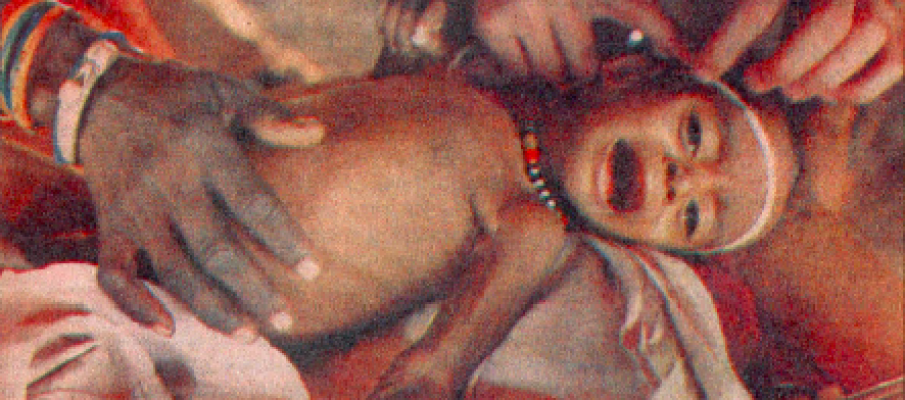
”Look, look! He closed her mouth.” The white-haired physician, known only as Dr. Elmer, stands a few feet from the rope bed in the center of the Swiss Red Cross clinic at Wad Sherife and witnesses the midday death: It is a scene he must watch all too often. But it is the playing out of life’s ultimate drama, and it never loses its sad fascination.
The young woman’s death certificate was completed and signed several minutes ago, although her chest still heaves with an occasional, rattling breath. Her actual death has become a formality, a matter of her lungs realizing her heart has surrendered.
“She is dead. They die here, you know.” Dr. Elmer speaks rather impatiently to a bewildered visitor, not wanting to explain that here dead simply means beyond saving. “Her heart cannot continue. There is no more.”
When you have severe malnutrition and dehydration, then you can rehydrate them for two weeks and suddenly they die because the heart simply cannot take anymore.”
So Zeynbe Mohamed is dead, even though her body still shudders with the effort to breathe, as if it is unwilling to let go of a life that has known little but suffering.
An old man sits at the foot of her bed, holding her bare feet steady as the last spasms jerk through her body. “For four months she is very ill in my country,” he says. ”When I came to this country, I came to this clinic. I have been three days in this clinic. I didn’t know she was this ill.”
The old man is her father. An even older man, her husband, sits at the other end of the bed, cradling Zeynbe’s head in his lap and washing her face with water from a plastic cup. His gnarled fingers brush the braids back from her forehead, and firmly stroke downward along her face, resting each time on the eyes as he tries to close them, then moving down to the mouth. He massages the muscles, working to relax the lips that stretch back over her teeth as her body instinctively gasps for air.
The men are not fighting death as Zeynbe is. They know it is her time. Her husband ordered the medics to remove the intravenous tubes that were keeping his young wife alive long past hope.
The woman has two children; one a year old, the another almost 4. She is of indeterminant age. Her father says she is 24, but her death certificate lists her as a teenager. It is not uncommon for a Moslem man to take a much younger bride as a second, third or fourth wife, or for a girl to have babies before she is 15. Her body under the faded pink-and-yellow blanket gives no clues: It has been shriveled by hunger to the shape of a small boy.
The family’s silent vigil is witnessed by the doctor two visitors. African medics have already moved on to tend to the clinic’s 50 other patients: Few have in even chance at survival.
But there will be no pictorial record of Zeynbe Mohamed. “No more pictures,” Dr. Jean-Marie Tromme, tile clinic’s medical director, tells the visitors earlier. “I am tired of the cameras intruding on death. One television crew interrupted a funeral and made them start over because they didn’t have the right shot. ”I just want to protect the patients a little bit. Sometimes it is all I can do for them.”
FEB.19 TUESDAY NIGHT,
lN WAD SHERIFE
Today I met the child I knew I would. She is a tall leggy beauty, with broad cheekbones, deep dimples and long bushy braids. She is so thin, but very beautiful already at 12 or 13. She will be a stunning woman, given a chance. She took a liking to me, and captured my heart. Her name is Brigdia, or some such, and I know nothing about her beyond her smile. Jean took pictures, so I’ll have that. But this is one I have become all too deeply attached to. And it hurts to know that I will never see her again, or know has become of her. I can only trust that Allah fi, God is there.
When I was a little girl, one of my favorite alone games was What If. What If I had been born in some faraway, exotic land? Would I be a famous ice skater, or a pioneer for underdog causes, or a noted humanitarian? Would I take my smarts and my talents and my skills and set some other world on lire? Well, now I have the answer to my What If game. Because no amount of intelligence or talent or dreaming will take you very far if you have the plain rotten luck to be born black and female in a war-torn country or a refugee camp in the poorest continent on Earth.
The boy Hajaj came to the Wad Sherife day clinic too Sick from hunger to eat. At 10, he was no taller than a child half his age. The nurses fed him water until he was strong enough to drink milk. They fed him milk until he was strong enough to eat porridge. And porridge until he was strong enough to eat bread.
Now Hajaj is stronger, and gets food every day. But there are some things a child does not forget. Nurse Susan Smith tells the story:
“One day I gave him an extra piece of bread as a treat. It was really small He tore it the half and very slowly ate half and put the rest in his pocket. The next day I gave him another piece and he did exactly the same thing. Today I gave him four small pieces of candy. And if you look in his pocket, two are still there.”
FEB.20 WEDNESDAY MORNING,
IN WAD SHERIFE
As our time here grows short, I am trying to put off thoughts of home and Don and all the comfort that is there. It makes me an at once too homesick – and unwilling to continue here – and too guilty that I have so much (and want more) when others have less than nothing.
Fatna Mohamed is the poorest of the poor at Wad Sherife – a reminder that, even here, there is always someone with less.
She lives with what remains of her family in Shelter H1841, the tiniest of a tiny row of straw lean-tos at the edge of camp, bordering on the treeless defecation field. Visible on the eastern horizon are the mountains of her homeland, Eritrea. On warm nights, the family sleeps on a mat outside the hut, under the radiant desert stars. When it is cold, they huddle together in the lean-to, four people curled on a dirt patch no bigger than a kitchen rug.
They have nothing of their own. Fatna’s black print tobe is cheap polyester made in Taiwan, a gift from a villager. The children wear cast-offs from the camp clinic. In the shelter, there is only an empty water jug, an empty medicine bottle, an empty gourd, an empty straw bag, an empty tin can and a straw broom to sweep the dirt floor.
Yet Fatna smiles shyly when she is questioned by a visitor, and laughs at the games of the neighbor children.
“We are giving her food to make her happy. That is why she laughs,” says Zemuy Ghebremeakel, a, medic at the Lalmba-American Refugee Committee clinic.
“If we leave from here and she has no food, then maybe she will be crying again. The main thing is to have food.”
Fatna left Eritrea in November with her father, her two youngest sons and a younger sister. “We were hungry, and there was the fire,” she says. Zemuy explains that “fire” means the war between the Eritrean rebels and the Ethiopian Dergue.
Two other children stayed behind with Fatna’s mother. There was not enough food for all to stay, and not enough strength for all to leave. She doesn’t know where her husband is; he left home five years ago, a few days after the birth of the youngest child, Salih Edris.
“He can’t provide for them, and he doesn’t want to see with his eyes the suffering of his children, so be escaped from them,” Fatna says. There is no judgement in her voice.
The family walked for two weeks to Wad Sherife, and were among the first to reach a refugee camp that did not yet exist. There was no food and water. Fatna’s father died, she and the children became sick. A medic from the clinic found them near death, sleeping without shelter from the chilly winter nights.
“When first we see them, none of them can even drink water,”‘ Zemuy says. After two months of nurturing by the clinic staff, Fatna and the older children are well but the baby, Salih remains frail, a gaunt skeleton who breathes. He spends each day at the clinic, drinking sugared milk. When the clinic closes in the midafternoon, he is brought home to lie on a mat shaded by the straw wall of a neighbor’s hut. He lies for hours on his back, his only movement the shallow heaving of his chest. He has not smiled in three months; any illness could kill him. Occasionally, he touches his mother’s tobe, his way of asking for more milk.
The nurses from the clinic send two cups of milk home for Salih each day. But after 3 p.m., when the clinic closes, Fatna and the other children eat no more until the next morning. They get no food rations because they spend each day at the clinic: There is nobody to wait in line for the grain. Even if they had grain, or spaghetti, Fatna has no cooking pots, not even a flat tin to fry injera, the unleavened bread. ”I do nothing here, only sit,” Fatna says. “I am only just myself. I am without any parents. But no one can survive any longer in my village, so I came to a place where there is food. And if I am getting food, and if I am not hearing the sounds, the instruments of war, that is enough for me.”
She spends her days praying, asking Allah for “food. Food and health and peach to return me to Eritrea to my village.”
As for the boy Salih, she says, “It’s up to God.”
FEB. 20 WEDNESDAY MIDNIGHT,
IN WAD SHERIFE
In the midst of all this madness, there is much brightness and life. Today while we sat in the clinic watching an old man struggle with pneumonia, a wedding dance marched by outside. And a visit to the home of one of the poorest of the refugees evolved into a laughing game of Duck Duck Goose and Ring Around the Rosie with dozens of thrilled children.
They are so quick. They understand no English, and are from a culture that doesn’t know yard games. Yet they grasped the concept of our American games instantly, and kept us hustling through the tbornbushes to escape from being “It.”
At the Lalmba-American Refugee Committee tclinic in Wad Sherife, relief workers dole out hugs and wait for the children to smile.
The hugs – are prescribed when food and medicine are not enough, when the sickness of the body has invaded the soul and drained a small child of the will to live. The smiles are the signs of survival.
Sister Terry Shields sits on a rope bed in that small clinic, cradling a thin boy in her arms and cooing, begging him to smile. She is worried.
“His mother died four months ago and he’s been sick for three months. He won’t eat. He won’t smile. I told the father to hold him because he needs love as much as anything else.”
The boy, Busein Adem, is 5. He looks no older than 2. A body doesn’t grow when it has no food.
Shields rocks Huseln awhile longer, nuzzling his sunken cheek and kissing his shaved head and talking bright nonsense in his ear. He clings to her tightly, but he does not cry or even whimper. Finally, she unwraps the stick-thin arms from around her neck and hands the boy back to his father. She moves on to her other patients, always chatting, always smiling, always looking tor that return smile that says they are ready to live.
The father takes his turn on the rope bed, his son’s too-small body curled in his lap. An older child, a girl with a topknot of bushy black hair and a long string of orange-and-green beads, sits nearby, just close enough to touch her father’s arm. “The Eritrean men are wonderful,” Shields says. “I love watching them with the children. They’re very affectionate, never rough.
“But it’s still only half enough.”
Some time later, the father gently rights his son, supporting the weak body” with his chest. He accepts a hardboiled egg from a nurse, peels it and gives it to Husein. The boy takes the egg, which is bigger than his hand, and eats it, sharing it with a dozen flies.
“His father and sister come every day they can,” Shields say. “But when the father hears his name called in the food ration line, then he can’t come in, so he leaves Husein home with the sister.”
This is not one of those days. Today the boy will eat, but the father and the little girl will not.
More than half the children who have come to Wad Sherife sulffer from malnutrition. A few have kwashiorkor, a protein deficiency that bloated the bellies of Biafrian children 15 years ago. But most of them are simply marasmic, starving from a sheer lack of calories. Their arms are no bigger than the thumb of a healthy adult; their faces stretch like drums over their skulls, giving them the haunted look of miniature ancients; their stomachs are like PlayDoh, refusing to spring back ‘to place after they are pinched; their bottoms hang in scores of baggy wrinkles, with none of the plump softness that pads the first falls of American toddlers.
Shields was in Biafra, and now she is in Sudan. She has seen the kwashiorkor babies, and now she sees the marasmic. The treatment is the same: food.
“It’s hard to know what’s horrible and what isn’t horrible. You see one starving kid, and that’s horrible,” she says. “Biafra was bad, but it was different than this. Once the fighting was over there, they could go back to their farms and try to make a life for themselves. Here, the fighting won’t stop. There is no future.”
There is not much reason to smile.
FEB. 21 THURSDAY,
IN SHOWAK
Today I found the place of my dream — the flat desert stretch outside Wad Sherife. Hot yellow sand, blinding sky, shimmery mountains in the distance. But no people walking. Just an occasional lorry or camel carcass.
We are back in Showak, with friends. Tomorrow we’ll visit the folks at Wad el Hilewu.
I am growing more anxious to be home as the time draws nearer, but today also realized I will be sad to leave. It seems like forever ago that I hugged Don goodbye. It’s been a three-week trip through life that may alter my perspective forever. Much as I long for a clean shower and non-smelly flush toilet, I also know this kind of experience may never come again, and I am reluctant to leave it undone.
Two babies Hassan and Ali, lie on a hard, wooden table In a straw-sided clinic at ~ad el Hilewu, covered with heavy wool blankets despite the late-afternoon heat. Both are 5 months old. Both weigh less than 8 pounds – less than most newborns.
Before the night is out, one will live and one will die.
Hassan was brought to the clinic a week earlier, malnourished and dehydrated. He is too weak to suck from his mother’s breast. Even if he could, the milk never stays in him, but runs through his wasted body as if it were a funnel. The finger-like nerves of his stomach have gone so long without nourishment that they have shriveled, no longer able to hold what little food is coaxed down his throat. His mother, Asha Osman, has held him patiently on her lap for those seven days, wiping the vomit and diarrhea from him with her tobe, an exquisite green gauze stitched with silver thread.
Sister Patrice Coo lick and Dr. Karen Kruger lift Hassan from his mother’s lap and lay him on the table 1near a glassless window. There is no electricity here and the afternoon light is fading fast, making it difficult to see the tiny veins that might hold an intravenous tube for a few life-saving hours.
The women work over the infant for more than an hour, searching his body for a vein large enough to hold a needle. His arms are tracked with needle marks from earlier IVs, so they look for a vein in his scalp, Kruger discards the stretchy tubing that serves as a tourniquet; it is too loose. Instead, she wraps a common rubber band around Hassan’s head. His haie less scalp becomes an intricate network of blue as the veins bulge to the surface.
Still the needle, no thicker than a thread, cannot find its mark. The baby’s head is dotted with pinpricks which grow to bruise spots as the needle is inserted, then breaks through the parchment-thin skin, and is inserted again.
Kruger leans over the baby and continues her search. Each time the needle breaks a new patch of skin, she murmurs to him. Her voice is strained and thin. “I’m sorry, baby. I’m sorry, baby. Please forgive me. I am so sorry.”
Finally the women return the needle to an overused vein in Hassan’s arm, taping his hand to the table so he doesn’t rip the needle out when he moves. Then they turn to Ali, a carbon-copy of Hassan in his wizened thinness. This baby is even sicker and has been losing weight. His eyes roll back in his head, then flutter forward, then roll back again. It is not a good sign. His breathing is shallow, erratic and quick.
“When they start breathing like that, they’re pretty far gone,” Kruger says, almost to herself.
Kruger and Coolick make room on the table for Ali but are reluctant to start the IV. Coolick instructs an Eritrean medic to tell Ali’s mother, Fatna Adem, that the medicine may not work.
“She has to understand that it’s not magic,” Coolick says. “The baby’s been sick too long. Maybe with the IV he’ll gain the strength to start sucking again, but we can’t promise.”
Kroger looks pained. “I can’t not try it.”
“Me either,” Coolick assures her. “But I just want to make sure the mother understands. Because if we put that IV in and 10 minutes later be dies …”
So the mother is told, and the IV is inserted. But there’s no telling if she really understands, or if love and hope have convinced her that surely the doctors’ medicine will work, that her baby cannot die. She stands over Ali and pats his chest lightly, as if to remind his tired lungs to breathe.
The babies, Hassan and Ali, lie there, side by side, life dripping into them from small bottles banging from a branch in the thatched roof. Their mothers, Asha and Fatna, stand over them, waiting. Asha, the older of the women, leans over Hassan, squeezing breast milk into his hungry mouth. It is a slow process and her back must ache. But she will stand there as long as he will drink. Fatna watches her, then does the same. Outside, in the fading light, a toddler wails in surprise and indignation as her arm is pricked for a measles inoculation. The healthy squawl slices the unnatural quiet of the straw clinic, a reminder that babies inside are too sick to cry.
Kruger checks the babies once more, then quickly loaves the clinic to sit for a few moments in a dark room. She is new at this work.
“You can bear about it and sit in the slide shows and you think you know what it’s like,” she says. “But you see it in person and it’s a whole different feeling. When you hear so many died in one day, it’s different than when you see them die.”
She sits in the dirt, resting her head in her arms and talking quietly, convincing herself it’s alright.
“The kids are so much sicker here than at home, and you have so much less to worry with. Obviously we make a difference. Those kids would be dead already if we hadn’t put in the IVs, and now maybe they won’t die. . .
“But children are children. Why should a kid in the States not even have to worry about measles, when it’s such a killer here? It’s not a medical problem. I think it’s a distribution problem. It’s economic and political . . . The amazing thing about kids is if they’re halfway healthy, they’re happy. They’ll find a pebble to play with or come and play with you. They don’t care that they’re in a beat-up old rag. They’re are happy.”
She takes a deep, shaky breath. “But you can’t compare it to what it’d be like if you were at Baylor. You have to compare it to what it’d be like if you weren’t here at all. That’s what my boss said just before I left. If nine kids die and one lives because you were there, don’t get depressed about the nine. Feel good about the one.” “I think that’s easier said than done.” She sighs, dusts off her skirt, and returns to work.
At dawn the next day, Asha is again standing over Hassan as he sleeps on the wooden table. Her vigil continues.
But Ali has died. Fatna moans and rips at herself until her husband shakes her by the shouders. “Quiet,” he orders. “Allah fi. God is here.”
Kruger, too, cries. She is comfirted by the news that, during the night, a baby was born in the tent village. The mother died, but the premature baby is healthy. Medics are taking bottled milk to the home and are seeking wet nurse to take the child.
“One dies, another is born,” says Jerilyn Green, another nurse. “That’s the way of the world. God has his purposes, even if we don’t know what they are.”