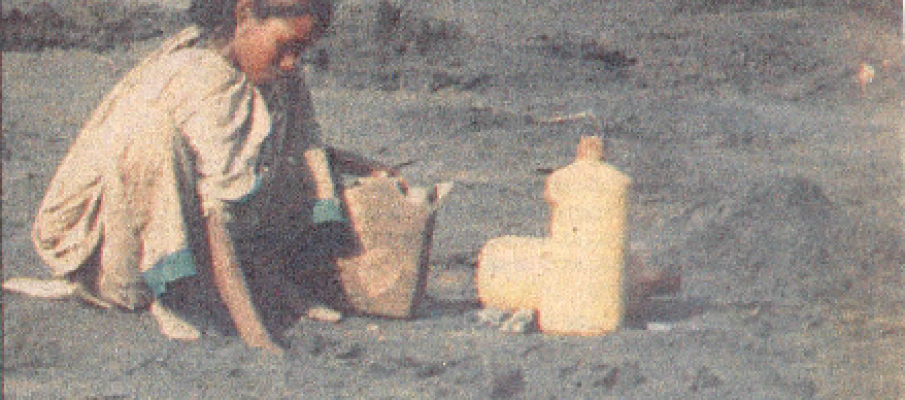
FEB.12 TUESDAY NIGHT,
IN GEDAREF
If my pen is shaking, it is fitting. Twice today, people have told Jean and me we are brave. Right now, I feel anything but. I feel shaken and scared and like having a good cry. Or a cold beer. Either would do. (Although a beer right now would certainly lead to a cry.) We changed our plans to stay at Wad el Hilewu after bearing that the camp at Wad Kowli was down to a two-day water supply and people were being trucked out en masse. That launched an exhausting search for transportation here to Gedaref, and lodging once we arrived. In desperation, I finally invited myself into a full guest house, and got adopted by two Arizona doctors who gave us a mattress on the veranda and the key to the pit latrine.
Tomorrow, ensh’Allah, we move to the heart of the story: Wad Kowli, by all accounts a living hell. I don’t. know that we’re prepared logistically, foodwise, or emotionally. But it must be done and it’s long past time.
They arrive at sunrise, sometimes only a few; sometimes whole villages, portraits of sepia in the morning haze. The walked through the night, as they walked for a month of nights to reach this sorry refuge. By day they cannot travel: The sun is too hot; the water too scarce, the bombs of the Dergue too accurate.
Only the strongest make it this far.
“There are some springs along the way,” says Ernie Tanner, a pilot who flies food and medicine into Ethiopia for Helimission, a Swiss relief agency. “Or they go to the dried riverbeds and dig for small puddles. And if they don’t find water, they die.”
They are escorted the final miles of the journey, from the border of their homeland to the Wad Kowli refugee camp, by the Relief Society of Tigray. During their walk through Tigray, they are watched over by the Tigrayan People’s Liberation Front. The antigovernment forces guard as many as 40 checkpoints through Tigray to feed famine victims on their journey west. It is better to have followers living outside the country than no followers at all.
Still, many die. Perhaps they wait too long to leave their homes, or fall sick for the fetid water, or just give up.
“The flame goes out. They just live on psychological energy, and once that leaves, there’s nothing. So they die,” Tanner says. “They lie like carcasses on the road, like the camels and the cattle you see here, and there is no one to bury them. They don’t have the strength or the tools. They just pile stones on the bodies and move on.”
They walk in from the east, through a thin stand of acacia trees and to the top of a hill overlooking Wad Kowli. Ethiopia is behind them, on the eastern horizon. They march single-file along the narrow trail of cleanlinesa that cuts through the defecation field, past the resident refugees squatting in dreary acceptance of nature, like so many stumps in a burned-over forest. The newcomers are barely noticed; they throw their arms over their noses as the smell of human waste assaults them.
They stop at the eastern edge of camp, under the gnarled branches of four ancient thorn trees. The fortunate few who own a blanket or an extra wrap spread their muslin over the branches to create a patch of shade. Most just sit where they stop, too tired to take another step, and gather their remaining loved ones near.
Then they wait.
“It’s really something. You can watch them walk in, over the hill, down the path, to the trees,” says Louise Dyer, a Save the Children nurse from South Wales. “But there are no shelters for them. They have to build their own. They find what they can, when they can, where they can.”
But before they build, they must wait. Refugees first stand in long lines to register. They move to another line to have their children weighted and measured, another line for triage health screening, another for measles inoculations and Vitamin A, and still another for food rations. It is good practice for life at Wad Kowli, where patience is not a virtue but a necessity. There are lines to see nurses at the out-patient clinics, lines to get children into the supplementary feeding centers, lines down-the river hank to the watering hole, lines out to the defecation field, lines at the overworked flour mill. And lines up the thornbush hill to the cemetery.
“As bad as this is, they keep coming,” Dyer says. “It makes you wonder what sort of conditions they were living in to drive them from their homes, to this. It must have been desperate.”
Wad Kowli covers about one square kilometer of beleaguered land along the Atbara River; certainly no more than two. Walking from end to end takes 10 minutes. The perimeter cati1 be circled in little more than half an hour.
More than 90,000 people live here in late February. The first arrived Dec. 19, stopping on their walk west because they found a promising pool of water where the Atbara once ran. By New Year’s Day, there were 44,000. Two weeks later, there were 81,200. And by mid-February, 94,700. Camp officials estimate that each refugee has three square meters of space. The U.N. refugee commission recommended minimum is 20 square meters per person. The World Health Organization recomends 30.
No one told the refugees about recommended minimums. People eat and sleep, defecate and vomit, hug and dance, laugh and sing, live and die in public, scant inches from their neighbors.
The straw huts share walls to conserve space. Tents are pitched so close the guy-lines overlap. A single hut, perhaps 10 feet by 10 feet, sometimes houses four familiess, 15 to 20 people. Women cook, children urinate and grown men bathe in the small patches of dirt in front of their shelters, usually in full view of the thousands of people who walk by from long before dawn to long after dusk.
The sick and the small defecate there, too, their waste pounded into the dust by the bare feet of the multitudes. Those who are strong enough, healthy enough or modest enough walk to the vast defecation fields that ring the camp. Some walk beyond the fields to seek even more privacy, or huddle behind the skinny shield of a thornbush. But most have accepted the need to squat in the open fields. The women pull their skirts past their knees to the ground and draw their wraps over their faces, as if to create their own cloistered bathrooms.
FEB. 13 WEDNESDAY NOON, IN WAD KOWLI
IN WAD KOWLI
It is the hot of the day. The thin wall of a straw tukl, as dry and brittle as the Horn of Africa, separates us from one of history’s great horrors. It could as well be a wall of life-sustaining water, with those on this side able to drink and those on the other side only able to watch, and wish. Or it could be a wall of money, the same wall that separates rich and poor, healthy and hopeless, Western and Third World, throughout the Earth.
Through that wall we bear the rumble of humanity. Ninety-two thousand stuffed onto a square kilometer of desert that long ago gave up its will to live and has little life to offer the people who have traveled so far to get here.
The rumble is a blur of voices, most undistinguishable. It is easy to forget they belong to individuals: real people with families and dreams and suffering. From this side of the wall, the voices blend into the background – almost as a freeway or ocean becomes one with an environment, so no longer noticed. From here they are almost easy, or almost necessary, to forget.
But occasionally, life asserts itself. A man yells to a child, possibly urging him not to stray so far from what is now called home. Or a baby wails from hunger or fear or fright. Or a child’s voice, light and delightful despite this outrage, squeals the one word that bas become all too familiar; KHAWAJA! Foreigner!
Then it is impossible to ignore the rumble, and the wall once again is only straw.
The sounds bring back the visions of the day: scenes of horror and glimpses of hope. Everywhere we walked on our first brief tour, the children followed, lighting on us like men, hoping for I don’t know what. Perhaps I don’t want to know since I have nothing to give them.
Take a walk through Wad Kowli. Feel the press of humanity against your flesh. Feel the weight, burden, the pitiful stares of the suffering. Stand there, engulfed by the multitudes as they reach for your band, tug at your arm, plead with their eyes.
The first to come are the children. They surround you in ever-expanding circles as you walk along the crowded footpaths of the camp. They run from their huts, hands extended, shouting salaam, hello. They want to hold your hand, several of them at once, and soon are draped from every part of you like tarnished jewelry.
Some of the children cannot run and play. They are loaded down with heavy cans of water, or stacks of wood balanced on their shoulders. The older ones carry the younger ones, toddlers strapped to their backs and infants cradled in their arms. But even they find a free hand to reach out in greeting to the khawaja.
For the children, you become a toy in a world without toys, a momentary diversion from the drudgery of lugging water or waiting in line or picking lice from one another’s hair. They give all they have: shy smiles, laughter, handshakes. They ask little in return: They will be satisfied with a smile or nod, are delighted with some basic conversation in their tribal tongue, and are thrilled with a hug, shivering in excitement and running home to their mothers to share the news.
It is not so easy with the adults. Their burdens are heavier, their memories longer, their needs greater.
As you walk, a tan youth – a young man here – beckons from the defecation field, where he stands over a sick boy squatting in dust. He holds out his hands in a silent plea. Walk to the thatch-roofed clinic where 1,200 people wait to set! four nurses. A young woman approaches, thinking you are a doctor. She pulls her veil from her face, revealing a festering sore on her neck.
Walk through the massive feeding center, along the rows of skinny children clutching their plastic cups and sitting very still lest they spill a single drop of that day’s milk. A man rushes in, cradling his naked son in his arms. He pauses a moment as his eyes adjust to the sudden shade under the straw roof, then he brings you his son, gently tipping him bottom up. The boy is turning inside-out with sickness: Giant red polyps protrude from his rectum, the result of diarrhea that won’t stop.
Walk up’ the hillside for some fresher air, along the river where the people live under the trees. An old, old woman is there, tugging on your sleeve and pulling you up a small knoll. She stoops to the ground, lifting a rumpled green blanket that is black with swarming flies. Through the angry buzzing, you see a wasted figure, too thin to make an impression under the blanket: perhaps a sick boy, 10 or 12, with narrow shoulders and a skinny, flat chest. Then you pick up a yellow registration card and read that this person is Giney Giinesku, a young woman, 20 years old. She came here alone – her family died in Ethiopia or on the journey here – and had no one to care for her when she fell sick. The old woman, who lives under a neighboring tree, found her like this.
The brazen flies now cover Gineys face, searching for the moisture in her mouth and nose and marching across her eyelids. Their pestering wakes her. She opens her eyes and looks up. You look at her, but dare not meet her eyes. For if you do, you will betray the truth: You have nothing to give. You look away, and keep walking.
FEB.13 WEDNESDAY NlGHT,
IN WAD KOWLI
I am writing by kerosene lantern in stifling hot tukl as I listen to the voice of starving Africa all around me. It is our fifth night without electricity. I have bathed from a bucket, standing atop a pile of black rocks in a round of-straw mats. The pit latrines are similar affairs; thick with bold flies. But once again I feel very lucky to have a half-bucket of water for washing, a rope mattress to bold my sleeping bag off the ground and straw walls to keep out the worst fears of the night…
There is a child coughing constantly and deeply on the other side of that straw wall. I will consider it a miracle if she (he?) is still coughing in the morning. It is very noisy, and the night sounds are somehow worse without vision. While we walked this afternoon, at least we saw the smiles of the women and the laughing children, and the families pursuing some semblance of a routine. Those signs of normalcy and everyday life seemed to take the edge off the rest. But the night sounds grow, and are terrible. I can’t see to know if the cougher, the screamer, the wailer, are all right.
I think of today’s visions and realize the disturbing tendency to shut out what is too horrible. I could show friends – anyone – a picture of a singer baby with flies crawling fearlessly in and out of her lethargic mouth, or of a mother holding her child’s clubfoot as if love alone will make it better since it is all she has to give, or of a man staring at the khawaja with begging eyes that have long since lost their pride.
And that one picture would move hearts. But when you see that scene multiplied tens and hundreds and thousands of times, it is too much. The heart hardens against it and the eyes glaze over. The mind refuses to register the enormity of the horror.
I would like to be gone from here – from the night sounds that leap the thin straw wall into my soul. I would like to be sate and comfortable at home, worried only about my widening waistline and my boring wardrobe. Sipping a gin and tonic and squabbling with Don. Trekkling to the refrigerator out of sheer boredom and the exhilaration of tasting food on my tongue – food I have Jess than no need for. It is all so crass. And right now I want it very much.
Tomorrow is Valentine’s Day, and I must open my card from Don. I will cry then. It will be a good excuse.
Children are the wealth and legacy of Africa. They also are its burden, as a starving continent realizes it can no longer feed them. A recent study by the U.N. Food and Agricultural Organization places the African population at 540 million, doubled from a quarter century ago. The agency projects the population will increase another 80 percent by the year 2000, to almost 9010 million; then almost double again – to 1.6 billion – by 2025. “Family planning doesn’t exist here,” says Dr. Linda Soran of the Lalmba Association. ”They have some strong cultural beliefs against birth control. Some of the more educated women come to the clinic and ask for it, but they don’t want their husbands to know.” The burgeoning population is the result of improving health techniques, slight declines the death rate (life expectancy has risen from 40 to 49 in many developing nations), and steady increases in the birth rate. Most women give birth to six or seven children.
Population increases are estimated at 3 percent a year across Africa, compared to 2 percent for the developing world as a whole.
But increases in food production have been slower, rising at a rate of only 1.8 percent a year during the 1970s. While Africa enjoyed food surpluses in the first half of the century, and was self-sufficient through the 1950s, it has not been able to feed itself for the past 20 years.
There seems little incentive for population control in much of Africa, where infant mortality rates still top 10 percent and child mortality rates (for 1- to 5-year-olds) are 15 to 20 percent. In farm families, children begin to share the workload at an early age. They remain the continent’s only social security system for the aged.
“Children are treasured here,” says Sister Terry Shields, a Lalmba Association nurse. ‘There’s a lot of affection shown to them, from their own family and the whole community. They are lent out for others to take care of, and are taken in if they are orphaned. They’re a family’s only future.”
FEB.14 THURSDAY SUNRISE,
IN WAD KOWLI
I heard the first children playing well before daybreak. The refugees were awake and bustling by 5 a.m. to take full advantage of the light for their tedious but essential chores…
It is a beautiful morning, as all are here. The sun is just now piercing the open doorway of this tukl and lighting this page. It is relatively cool – a reprieve will only last a few hours. By day, the dust replaces the campfire smoke to cast all in a hot haze.
Jean and I savored our breakfast of a shared grapefruit and box of raisins. It’s the third day on rations – only bread in the mornings, with a bit of fruit. No lunch or supper, although it’s too hot and exhausting to want to eat much.
Alem Desta sits in his father’s lap, drinking sloppily from the green plastic cup his father holds for him. At 20 months, the boy is too small and too weak to hold the cup himself, and sometimes he forgets to swallow, his belly is a mass of wrinkles, the pale skin still stretched from the swelling of hunger. His eyes, huge and listless, haunt his sunken face. He does not smile or wiggle, just leans against his father’s chest. When he doesn’t drink, he dozes, or stares, or whimpers for a few moments until the strength leaves him again.
“For one month, and two weeks we have come to the feeding program,” says Desta Belay, the boy’s father. ”We took him to the clinic two times, and the doctors sent us back here for more food.”
The doctors say he is getting better.
But sitting on the next mat, 2-year-old Mebrat Kedane is losing weight. The milk no longer stays in her, so she is fed a solution of sugar, salt and water through a tube in her nose.
“One daughter is dead here because of the sickness,” says Mebrat’s father, Kedane Fekaden. He is an old man, already 50. His heels are split and scabby from walking 38 days to reach Wad Kowli. Tears pool in the hollows beneath his eyes as he talks. Kedane’s wife is dead, too. She died of “a cough,” he says, soon after the family arrived in early February.
Medics speculate she had tuberculosis. “I now have only three children, and they are sick,” he says.
Alem and Mebrat were born on farms but now are among 25 children in a critical feeding program at the YMCA feeding center here. They are children who lack the strength to eat, or have forgotten how, and must be fed through tubes or have spoonfuls of liquid dripped down their throats. Mothers sit for boors, squeezing breast milk onto spoons to feed their babies, who are too weak to suck.
Four thousand children come to the five feeding centers at Wad Kowli each day for milk and porridge, bonus calories for the malnourished. Another 3,000 children are identified as needing supplementary feedings, but fail to come to the centers. They are too sick, or they go with their parents to wait for the family’s grain ration, or they do not like the warm gruel served at the centers.
Children who weigh less than 80 percent of normal are fed three large cups of sugared milk and a bowl of porridge (flour, milk, oil and sugar) each day: a total of 1,350 calories. Skinnier children, who weigh less than 70 percent of normal, get extra milk and a high-energy biscuit, boosting their intake to 1,550 calories.
Food also is distributed to families to cook in their shelters – The basic daily ration is 400 grams of flour, 30 grams of oil, 10 grams of sugar and six grams of lentils per person – 1,800 to 2,000 calories. For those who are too weak to swallow, or have forgotten how to chew, there is “wet-feed:” grain mixed with water to go down easier.
Food deliveries throughout Sudan have improve since January, when CARE took over distribution. Still, the exact timing of grain deliveries is erratic, and quality is uneven. In early February, Wad Kowli received a shipment of grain mixed with sand. Later in the month, refugees at Safawa, a neighboring camp, became ill after eating grain hauled there from Wad Kowli. When there is no grain, refugees are given noodles or rice. When there is no oil, they pop the grain and eat the noodles dry. Twice since December, cattle have been brought to Wad Kowli – 40 rangy cows, as thin as the refugees, to be slaughtered in the camp and divided among 90,000 people.
There is a sudden soft thud of pressure against your legs, distracting you from your horror as you watch an endless line of skinny children wait for their dally ration of milk. You feel chubby arms wrap around your thighs and look down to see plump boy hugging you tight, rocking and giggling as he bounces off your knees. His front teeth are missing and he in wearing red plastic sandals. “Hi!” he grins.
The action is startling because it is so American, so normal, so healthy, so fat. He pulls at the camera hanging at your waist, pressing the buttons and twisting the lens. And he reaches boldly into your pocket, standing on his tiptoes to peer in. Then quite distinctly. quite irresistibly, he says, “Biscuit!”
The boy’s name is Geberesge. He is an orphan from Tigray. “When we first got him, he was very malnourished,” says Tesfaye Bekele, a worker at the feeding center. “But now he’s all right. He gets food whenever he asks, so there is no need to register him in the feeding program.”
Geberesge is 7 but looks no more than 4. “He will always be small, but in his mind he is alert,” Tesfaye says.
The boy’s father: a farmer, died of starvation in Ethiopia; his mother on the long journey to Sudan. “This child knows the days of his mother,” Tesfaye says. “Wnen you ask him, he will tell you she died on the way. But to any man who will treat him well, he will say, ‘You are my father.’ “
He lives now with leaders of the Relief Society of Tigray at their straw compound in the center. of the refugee camp. He spends his days playing with workers at the nearby YMCA feeding center, and teasing biscuits from the volunteers.
“Tomorrow for him is very difficult to know,” Tesfaye says. “If we can find someone who will take him, an Amerian volunteer maybe, that would be good.”
FEB.14 THURSDAY NIGHT,
IN WAD KOWLI
My mood is better tonight, despite the horrendous sights of the day. We had a productive workday and both are feeling more comfortable. Jean is still a bit perturbe by her inability to grab candids I by the impossibility to interview. How I want to let these people tell their own rich stories. But I get simple phrases that state the fact, not the emotion. So much for my great ambition to do what no other writer bas done and learn about the people. Now I feel I am just one more component that is playing on their misery, treating them as masses of cattle or sheep to be fed and watered and moved, rather than as individuals with personal hurts and problems. The things we saw today are indescribable. The children’s feeding center, the inpatient hospital, the mass evacuation… Only the healthy are evacuated, so the scene is not so heartrending on an individual basis. But to watch these people run through a paperwork assembly line, punched with needles, dusted with DDT, doled out a piece of bread and cup of milk.,then herded – quite literally – onto the backs of standard-issue lorries is a sight that should make the advantaged world weep with shame. There is even a monitor who beats people with a stick to make them sit down and pull their hands inside the truck bed.
And we saw the starving today – the babies with the bloated bellies too weak to eat, the 20-year-old man weighting only 64 pounds, the child who squatted in the road to expel all the nourishment in him. No one can truly do this story justice in words.
In parts of West Africa, children are not counted as members of the family until they have survived measles. There is no sense in counting a child who may well die. The custom is not the same in east Africa, but measles is no less feared.
“It ill a very good axiom,” says Dr. Serge Manoncourt, a medical coordinator for Medecins Sans Frontieres at Wad Kowli. ”The African knows what measles is, and how dangerous. It is one of the five codes of mortality in Africa.”
More than half the people dying at the Wad Kowli refugee camp each day are children under 5, although only 17 percent of the camp’s population is that age. The ratio is the same at other camps in the Eastern Region.
Most of the children die of measles. The other great killers are dysentery, diarrhea and dehydration, malaria, and pneumonia or other chest infections.
But measles is king.
“Measles by itself is not a killer, but measles combined with malnutrition can wipe out a population,” says Susan Smith, an American Refugee Committee nurse. “They don’t have the resistance and it spreads like wildfire when they live this close.”
Soon after relief workers arrived at the refugee camps in Eastern Sudan, they began vaccinating children under 5 for measles. When the disease began claiming older children, the vaccination effort expanded. But the infection already had taken hold. The frequent movement of soldiers and volunteers between camps thwarted any attempts to contain it.
Culture aids the enemy. Local tradition dictates that children with measles be left home, covered with heavy blankets in a dark room, deprived of food and water. The treatment often lasts for days, and is supplemented with primitive home medicines: burning patches on the chest and back, or “bleeding” the scalp and face with deep cuts.
“Many believe the children shouldn’t be exposed to the sun, and some believe the fairies cause measles,” says Dr. Linda Soran of the Lalmba Association. “So they put out food and gifts to keep the fairies happy. And they think the fairies won’t like it if they take the children out.”
Malnutrition rates in Eastern Sudan also are phenomenal. A nutrition survey conducted in early February by the U.N. refugee commission showed that 32 percent of the children at Wad Kowli were malnourished, weighing less than 80 percent of normal. Nine percent were severely malnourished, weighing less than 70 percent of normal.
At Wad Sherife, the figures were worse. The rate of malnourishment was 52 percent, while severe malnourishment was 20 percent.
“These are figures no one has ever heard of before and, unfortunately, they’re correct,” says Angela Berry, U.N. refugee commission nutrition coordinator. “Anything over 10 percent is a disaster.”