FEB. 8 FRIDAY
IN SHOWAK
The folks from the American Refugee Committee are wonderful, the kind of people with the inner peace necessary to tackle such a mission. And while they know that about themselves, they seem to harbor no disdain or even impatience for others who blind themselves to world pain and who refuse to be moved out of their own self-absorption.
Traveling here with them, getting to know them beyond a quick interview, bas been a delight. It will be most difficult to finally strike out on our own. What a fortunate way to be introduced to the Third World. I may not have been as open to the newness, as accepting of the differences, as fearless of the strangeness.
“When you agree to come, when you say yes to this, that implies a lot. When you go back to the field, you do it understanding three things.”
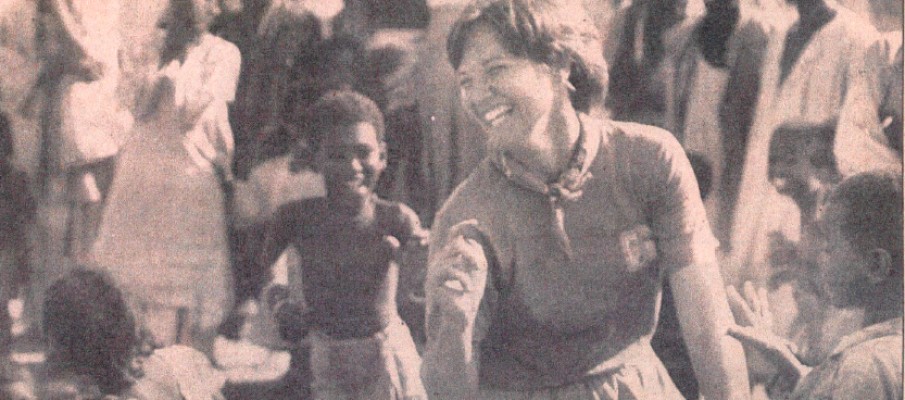
Patrice Coo lick spent 10 years working with villagers in the icy mountains o Peru before agreeing to come to Sudan, where the daytime temperatures top 110 degrees during the cool season. She is a cheerful, practical woman who is at ease bouncing in the back of a dump truck or sitting in the sand to examine a patient. Her quiet self-assurance has a calming effect on others. By virtue of personality and experience, she quickly becomes the unofficial “mom” of the American Refugee Committee team.
“First, you have to live with the consequences of your decisions. People can tell you that you did fine, you did the best you could. But you have to live with it.
“Second, in long-term development work, you’re always a foreigner. You grow close to people, you share their lives, they give you a lot of love. But ultimately, you’re an outsider. Some people can’t live like that. Some come to terms with it. I don’t like it, but I know that’s the way it is.
“And In crisis care, you have to deal with the fact that you just can’t do enough. So you have to keep busy, keep your mind working. You don’t let yourself stop long enough to be horrified.”
FEB.9 SATURDAY MORNING,
IN SHOWAK
Yesterday we visited Abuda with Kare.o Kruger, who will work with Linda Soran, the Lalmba doctor there. Karen jumped right in and did a consultation on a 6- month-old boy with meningitis. The baby’s mother, so tiny herself, sat with him on the rope bed, both wrapped in the same drapes of blanket and tobe (a sarong-like dress). The mother was eager to have the doctors examine him, but seemed so anxious and afraid. She finally got him to take some breast milk and that seemed to help – her as much as him, maybe.
Linda bas been here four months and apparently is feeling worn down by the work. “People die here who never would at home,” she told me. She’s confided to some of the others that she’s feeling inadequate in her attempts to help. If that’s the frustration here – where the situation is much more settled and controlled- I wonder how it is at the large border camps that are bulging with famine refugees.
“I have this idea in my head and in my heart about how I hope It works out here for me. But who knows? Sometimes my head and my heart are schizophrenic.”
Pediatrician Karen Kruger is the rookie of the American Refugee Commitee team, younger than the other medics and fresh out of medical school. She vows never to be a “rich American doc.”
She tends to be impatient with herself, often feels overwhelmed by the challenge she is confronting in Sudan and suffers for each of her patients. Her eager, light-hearted manner makes her an instant favorite with the refugee children, who run to her for hugs when she arrives at the camps each morning. They call her K.K.
“In my head, I think I came here with an idea. I have medical knowledge greater than people have access to in the Sudan. So, the hope is I can use the knowledge I have to do what I can and do preventative stuff before a kid gets critical.
“I love working with the kids, but it’s hard, too. When they’re in critical care and you see them all the time, you get real close to them. At Baylor I was always being told not to get so involved I was always off crying somewhere. Some people say that after you’ve done this for a long time, it doesn’t burt as much. And certainly it gets easier. But the hurting doesn’t ever go away. At least, I hope that doesn’t happen to me, I hope I never get to the point where it doesn’t hurt anymore.”
FEB.9 SATURDAY NIGHT,
IN SHOWAK
There is no electricity — hasn’t been all day — so I’m writing by kerosene lantern…
It’s rather nice here with no lights. Nightfall comes fast after an hour of the sweetest gold light that turns the desert into a jewel. The day have grown progressively hotter out here, as things build to the rainy season. The air is so dry it almost hurts to breathe.
Lips and skin are constantly chapped. Fingernails and heels split. There is no escaping the dust. The mornings are cool; some complain about the chill of the nights, but I delight in it. Evenings are blessedly breezy.
Since about 6 this evening, there bas been a steady drone of chanting and singing banging in the night air. It sounds like children’s voices, but it sounds too orchestrated to be random play. The sound becomes a soothing lull, and is occasionally punctuated by the barking mongrels, or a donkey braying, or the shout of adult conversation, or the clanging roar of an overtaxed truck bouncing by on the dusty ruts that pass for roads. Maybe the voices are praying; at times I hear what sounds like a litany.
The morning call to prayer comes about 4:30 each day, over a public address system that sounds for miles through the unimpeded deserts air… The Moslem men throw their prayer rugs wherever they happen to be at prayer time, face due east (even ifit‘s into the wall of a building or side of a truck), kneel, bow and pray.
We are such khawajas (white foreigners) here. We are taken advantage of at the market (although I feel guilty at the ridiculously cheap prices we pay), and people swarm around us trying to sell or have their pictures taken. Photographs are difficult because everyone is drawn to the camera. All the little kids and men run into the frame and stand stiff and stare right at you. The women are different; very few will let us photograph them. We were told today by Glen the artificial limb maker that women “are kept at the back of the house.”
There is little begging here – much less than in Khartoum, where beggars swarmed around the hotel waiting for the droppings of Western wealth. When the people beg, they stoop their shoulders and poke out their cupped bands ever so tentatively. It’s a very shameful, solicitous posture – not at all proud or defiant or even angry. I suppose that is only appropriate.
“You know bow sometimes the reality of what you’re doing suddenly seems to hit you and you think wow.”
Katherine Donohue still takes delight in the strangeness of new lands and comfort in the common kindnesses of strangers. And after several years in relief work, she still gets angry at injustice and outraged at pain. Her temper is softened by an easy laugh and a practical attitude, and by her ability to find the bright side of seemingly grim situations.
“I spent the last two years in South Carolina, working as a public health nurse with rural poor blacks. What I saw there was worse in many ways than what I saw in Thailand, because it was so preventable. But they say this was preventable, too, so I don’t know how I’ll rleact to that.
“I never get used to seeing it. Somebody needs to be able to do this work, and it’s good to be able to help. But that doesn’t mean your stomach doesn’t turn and you don’t get angry anymore.”
FEB. 10 SUNDAY NOON,
IN SHOWAK
Karen Kruger’s first patient died yesterday. Little Romodar Saed didn’t survive the meningitis that had invaded bhis brain and robbed his tiny body of health. Karen was at Abuda helping with immunizations when it happened. She returned to the compound quite shaken, talked to no one, and rushed out again. We found her later playing Ring Around the Rosie with a group of children down the street. An instinctively wise therapy.
I talked with her about it briefly today. She seemed OK: Last night we put a tape in the boom box and danced, and later she laughed and giggled until the wee hours with Susan Smith, who bas become her mentor and a buddy. We all did Jane Fonda exercises this morning She said the baby probably would have died had he been back at Baylor, her alma mater
Susan is such a great support for her. I just hope Susan finds someone to lean on when she needs it. With such a strong, bright personality, it is sometimes difficult to show weakness, and difficult for others to know when to reach out.
“I bad just gotten home from Thailand, in time for Christmas, when I heard about Nong Sumet wiped out, bombed into oblivion. And I asked myself, ‘What am I doing here In Canada?’ ”
Susan Smith has been working in various comers of the Third World for 10 years. Each time she finishes one relielf agency job, she finds another. For her, to less would be running away, ignoring the truth. She deals with the emotional pain involved through laughter, and spends time each day visiting the homes of refugee families to remind herself “what they have to work with.” Her energy and enthusiasm are motivators for the rest of the American Refugee Committee team.”I think I made my decision when I was 13. My dad got a job in West Pakistan and that was my first exposure to the outside world. It was the first time I realized that the whole world wasn’t like Canada and there were people who had very little.
“People always ask why, why I do this. I used to give all the stock answers. There’s a lot of rhetoric: There’s a sense of adventure, you meet new people, you work with people of like minds, people who are anti-Reagan and anti-nuclear and this and that and who have a global view and aren’t so provincial. And that’s all true, but that really doesn’t explain why.
“Then one day I read an interview with a nurse who works with Mother Teresa, and she said, ‘I have a strong sense of justice and what’s happening isn’t just.'” That’s it. That’s exactly how I feel.”
FEB. 10 SUNDAY NIGHT,
IN SHOWAK
Tonight I stood at the heart of the world. I walked to the middle of a field, with the sad-looking forest to my back, and watched the day meet the night. The sunset through the sand turned the sky pink and gold velvet; the night sky was indigo blue dotted with twinkling crystal. The feeling of completeness, of peace, was so deep that for those few moments little else seemed to matter.
“I feel totally at ease here. I feel like I’ve been given another chance at life.”
Jerilyn Green went home to Philadelphia after doing relief work in South Yemen and Thailand. She married, went back to school and pursued traditional nursing jobs in the United States. But something was missing. So when her marriage ended, she came to Sudan, where she tackles life with a wry sense o fhumor.
“I don’t know one medical person who’s gone back to a normal life after working in the Third World. I get a lot of pressure from my family and friends to come heme, settle down, buy a house, the whole security thing. That’s the American dream. And it’s a good one. But it’s not me. I hear a different drummer.
“You’re deprived of a normal life out here. Normal by any American standards, anyway. Especially in romantic relationships, let alone material things. And you have periods of total burnout. But you’re aware of it because you’ve been through it before, so you know what to do about it, you know to do little things that cheer you up. Like today, I was feeling totally bored. So I took a thorough shower and took out all my makeup and put it all on and now I feel great. Next week I may take out all my jewelry and adorn myself.
“Why do I do this? Oh, God. It’s so deep. Some of it can’t be explained. I think you’d understand if you were here long enough, if you could see what we get from these people. There s such a satisfaction and gratification. The appreciation is so great. It’s ego, a lot of it. You’re put on a pedestal. You’re so needed. You can’t get that anywhere else. Their appreciationIs so great, just for you being there and showing them things from your culture. They love you for it, and you lovethem for loving you. And it’s all continuous. It’s reinforced daily and hourly and every minute.
“I guess it’s akin to waking up one morning and discovering you’re a billionaire. Not even a millionaire. A billionaire.”
FEB. 11 MONDAY EVENING,
IN WAD EL HILEWU
I was ready for bed two hours ago with the sunset. And yet, all we accomplished today was what should have been a short trip from Showak to the Wad el Hliewu refugee camp. It’s an hour drivee but took us four. We started the morning by push-starting the car after tbe battery ran down inflating a flat tire; we had two more flats en route. The sun was blistering today, and seemed to leach the moisture right out of you. I felt woozy when we got to Wad el Hilewu, and spent more than an hour rehydrating.
This camp is an intriguing mix of settled and new, political and famine refugees. There is an established Sudanese village here of about 10,000. There also is a political refugee camp that sprang up a year ago. In recent weeks, the famine victims hve come, and the refugee population is now at 6,500. The medical clinic is similar t o those at the settlements of Abuda and Um Ali, but bigger and a bit more critical. The lines seem longer here, the children thinner, the sick weaker.
‘I don’t think they’d prefer this over home If there was something there. But if there’s nothing to go back to…”
Mark Litzow’s days grow longer as new refugees find their way across the border to the small hospital at Wad el Hilewu. He confides that it’s frustrating to work without sophisticated back-up systems, and to encounter diseases that are unheard of in the United States. His wife, nutritionist Kris Leru Litzow, meets life bead-on, charming villagers with patience and a warm smile.
Newly wed when they went to Sudan, the Litzows get each other through the hard times, sometimes with teases and sometimes with tears. They live in a straw tukl the edge of the village of Wad el Hilewu, where they often host parties for the African medics who work at the hospital.
“It’s not such a shock when you’re here. It’s not like seeing it on TV in your living room,” Mark Litzow says. “You find yourself wondering why you’re not more moved, but you see the kids up and running around. Maybe if you could drop from a plane into the middle of this, when the flies are suddenly all over you and you’re sweating and hungry and tired… When I think of what It would be like to live as these people do, I don’t think I could tolerate it. To be hungry and thirsty and hot and dirty all the time. I would just want to get up and leave.
“But these people have no place to go.”
FEB.11 MONDAY MIDNIGHT,
IN WAD EL HILEWU
The contrast doesn’t seem so stark when you’re here. It’s not like seeing starving babies on TV. Perhaps I’ve opened myself too much to Africa and left too many of my American expectations at home. People are hungry and sick and crippled and they die. But that is so much a part of life here. Children are hauntingly thin, still laugh and play. Mothers, who look weak themselves, proudly bold up their sick babies for pictures. The dying infants are adorned in bright beads and are so loved.
It’s very difficult to describe. Just as it’s difficult to explain why I can’t judge people here for using the streets as bathrooms and for not comprehending the thought of a wastebasket. I fear that much of what I write will make them seem ignorant. But that is not at all how I feel. The men are so proud and dignified. The women are shy and gracious and beautiful. The children are children, without a lot of the precociousness of American kids.
The drums began tonight at sundown, and the mysterious chanting some time later. It continues even now, over the barking of the feral dogs. I am no yet sure what it is. One of the medics says the children sing at night as their entertainment. But to me it sound like much more than that… as if there is something more than children singing.
When Edris and Fatna Salah left their home in Eritrea, they had seven children. After two weeks in Sudan, they have only five. Their journey brought them not to the promised land, as they had hoped, hut to the land of mumkin, maybe.
“Since as many as six years there is no rain and not enough food,” Edris says. He is a tall, lean man with a slash of a black mustache and a sad, ironic smile. “First there was no grain, and then not enough grass to feed the sheep and goats, so there was no milk and the animals died. And I was afraid of the struggle. They maybe will take me to fight in the Eritrean army.” The family walked for two weeks with others from their vitllage to Wad el Hilewu, a small refugee camp near the Ethiopian border.
“We wanted to live here because in Eritrea there is no rain, only hunger,” he says. “If we live here, we can get water, we can get food. So it is better here.”
But at Wad el Hilewu there also is sickness and death. About 6,500 refugees have found their way here, bringing with them measles, malaria and pneumonia. For several weeks, the water pump was broken; deliveries by commercial donkey wagons was sporadic. New refugees received only three or four liters of water a day, instead of the World Health Organization’s recommended 20. Early food distribution could not keep pace with the influx of refugees.
The death count skyrocketed, from 14 in December to 52 in January.
When Edris first arrived, he was afraid to come to the clinic.
”They think of the hospital as a place you go to die,” says Patrice Coolick, a physician’s assistant. It’s not their way.”
But Edris’ 7-year-old son was burning with a sickness home medicines could not cure. He brought the boy to the clinic, holding the small hand and watching silently as medics worked, feeding the boy intravenously and packing him in alcohol-soaked cotton to control the fever. And when be saw the boy grow stronger over the days, he brought in two more children, then two more, and then the last two. All were sick, as were Edris and Fatna. The family shared two rope beds, all the small clinic had to spare.
The 7 -year-old lived, but the oldest son and younger daughter did not. Fatna says there is no reason why some of her children lived, and some did not, just as there is no reason why they walked all this way to find life, only to die.
”When we talk she always holds her hand over her heart and talks about the two who died,” Coolick says. “But she won’t cry. She just says ensh’Allah, it is God’s will.”
And when Fatna is asked what the family will do next, if they will go home when the rains come, and plant the fields and watch their five children grow up, she says no. “Kalas,” she says. “Finished.'” They will walk no more. They will stay, rain or no rain. They will make this their home.
It is where the children are buried.